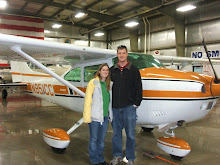
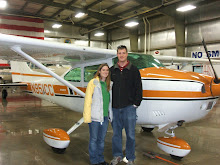
Adventures in N951CC our Cessna 182, and other random events
This is my first blog and I'm going to use it to journal the trips Michelle and I (and sometimes the dogs) take in our 1979 Cessna Skylane 182Q. I also post other stuff we do such as hiking and home improvements, but those aren't as interesting.
We took Chris on his first flight at 4 weeks old to California City for breakfast. He cried after we landed at California City because he was hungry and when we put his earplugs in on the way back, but he stopped crying before we took off. He slept both ways and never cried while we were flying.
Christopher's first flight - 4 weeks old.
Silicone ear plugs for hearing protection.
I like this photo, Chris is getting ready to go and I'm getting the plane ready, but where is Katie going?
Headset is a little big, but it's just extra precaution.
Mommy and Chris all ready to go.
This is the second flight with Katie's new headset, she LOVES talking on the intercom...
I've always loved getting outdoors and camping. Except for a few cases as a boy scout, I never really backpacked growing up. I started backpacking when we moved out the California near the Sierras and really enjoy it. I never get out as much as I'd like and haven't gotten out at all over the last few years since we started our family. Katie is now 2 and a half and since she's always been a good camper, I figured it was time to try to get back into backpacking and take her with me. This would also give Michelle a break from Katie while she's with Chris.
I was hoping to take her up Cottonwood Lakes and that would be 3.5 miles each way so I decided to take her on a test run. We walked from our house down the Bowman bike trail. She got tired around Sunland so we headed back. She walked the whole way except where this was no trail or sidewalk so I had her on my shoulders (got to test that out too). Overall we made it 2.4 miles non-stop. 3.5 miles with lots of stops should be no problem... Once I looked at the forecast for Cottonwood and saw it was supposed to be down to 29 degrees overnight, I started looking for another first hike. I found Packsaddle Cave online as an option and it's also in one of my hiking books. It's 4.8 miles round trip as a day hike with 2 campsites along the way. It gains 900 feet so it is considered moderate, doesn't sound so bad, so Packsaddle it is. Below are a bunch of photos that tell most of the rest of the story.
Here's Katie at the trail head ready for her "big long walk".
That 900 feet climb is pretty steep.
Throughout the hike, Katie would say, "the big long walk makes my tummy hungry" so we stopped to eat lots of snacks. Pretty soon all she wanted to do was just eat snacks.
So now she has to keep walking as she eats her snacks.
You can tell we're getting pretty high not too far from the road, it was pretty steep.
She's still going!
At the first river crossing. It wasn't as bright there because of all the shade from the trees,
but it wasn't that dark either; the flash messed up the photo.
Here's without the flash, but now it's a little blurry.
She's still going, this is about 2.1 miles into the hike. We stopped to take lots of water and snack breaks, but she started to take advantage of that and want a snack every ten feet. After I said she needed to keep going for awhile she needed to go potty. I showed her how to squat in the grass and that worked pretty good, but then she needed to go potty every 10 feet, so I told her she needed to keep going before going potty again, I was worried that would be a mistake. She ended up having no accidents on the entire trip and she was very proud that she pooped in the grass - yes we packed it out.
There were several river crossings like this. I put Katie up on my shoulders as I walked across these. Her job was to watch her head so she didn't get snagged by any leaves.
It was pretty lush down by the river.
We made it to the campsite at 7:30pm at dusk. I barely got the tent set up with minimal light at 8pm. Then it was time to eat.
This was Katie's first re-hydrated backpacking meal, she said she really liked it. Meat Lasagna, she ate about 2/3rds of it.
We finally made it to bed at 9pm after Triple Berry Cobbler for dessert.
Denver Omelet for breakfast.
She didn't care much for the eggs (they weren't very good) so she had trail mix for breakfast.
We didn't see any stars or the moon at night since we were in the shade of some big oaks, but she found the moon in the morning.
Packsaddle Cave entrance.
Going in to explore the cave, my airplane headlamp band went small enough to be perfect for Katie.
She really loved the cave, but that was muted because she wanted to head back.
I found a good rock for a timer picture.
The headlamps and camera flash don't show how dark it was. When we were in the back, we turned our lights off and it was totally pitch black.
Cave entrance on our way back out.
Some cave features
Daddy, I want to go back...
The flood flash totally ruined this photo. There was a small patch of moss that was growing in a narrow beam of sun through the entrance.
Heading out.
Looking back at the cave entrance.
I left the pack at the campsite instead of bringing it up to the cave. I found another good rock for a timer photo.
Another log river crossing.
You can't see the angle here, you have to walk up/down this log.
Top of a multi-tier waterfall.
The middle falls.
The lower falls.
On our way back home.
Had to hold the camera myself for this one.
It seemed like Katie was starting to get bored. She would just stand around and look at things. So I told her she needed to march march march like they do in the Mickey Mouse Clubhouse, then she wanted to start dancing. This worked for probably a half mile!
I saw several lifers on the trip that I'll never be able to identify, but I got a picture of the mustard colored bird. Maybe I can identify him from the picture...
At the saddle on the way back.
All downhill from here.
The trail on the far side.
We can see the cars!
Pretty steep downhill!
We saw a bunch of animals on this trip including lots of birds, some squirrels, 3 deer (Katie' thought they were big doggies), bats, a snake, and here's a picture of one of the lizards we saw.
Lunch at the Riverkern Cafe!
Overall, I'd have to say I thought the trip was excellent. She walked ~90% of the way and carried her own pack ~40% of the way. She learned to squat to pee out in the wilderness and didn't have any accidents. There were several times when she was getting bored or started to misbehave. This was very annoying since we had to keep hiking and she wore my patience thin, but 2 year olds have their moments and I think she was probably better behaved on this trip than on the average day at home.
Often on the beginning part of the hike she'd talk about how big she was and how she "wasn't too tiny and can go on big long walks with dad. Chris is with mom because he is too tiny." When she realized that we weren't going home to see mommy, she started saying, "I need mommy because I'm too tiny" it was very cute, but annoying. She was excellent for the camping part. She sat there very patiently while I struggled to set up the tent at dusk.
On the way back she got very upset that she hadn't cleaned her earrings. I was really trying to get her to not touch them with her filthy hands saying we have to wait until we get back home, but she was very upset about that. Like I said she had her moments... but overall, I think it was a great trip.
Satellite view of our trip using SPOT messenger for GPS tracking.
Terrain view of our trip. Checkpoint 17 was the last update for the night, but I think we were closer to 18 when we camped.
The only thing I would have changed was picking a trail that wasn't so steep. I'm already looking into Zion and maybe Sedona!!! Those will be camping with day hikes instead of backpacking, but should still be fun.
I bought a SPOT messenger as extra safety equipment for the airplane. It can be used to track the airplane in case of emergency. You can also track our flights for fun, just click the link below.